Access to Housing in Nepal: From Dialogue to Collective Action
Kathmandu | 5 May 2026
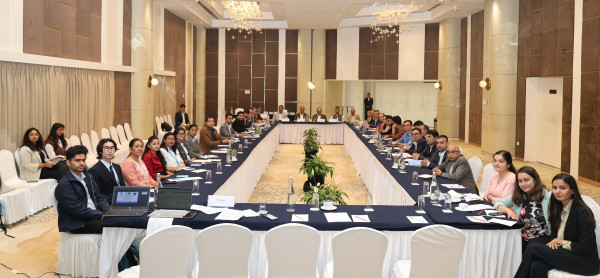
On April 03, 2026, the Ministry of Urban Development (MoUD), in collaboration with UN-Habitat Nepal, hosted a roundtable discussion on "Access to Housing in Nepal: From Dialogue to Collective Action" to tackle the increasing housing challenges in Nepal. The discussion, focused on inclusive and affordable social housing brought together government officials, urban planners, housing experts, academia, and social organizations. This event served as a prelude to the thirteenth session of the World Urban Forum (WUF 13), scheduled to take place in Baku, Azerbaijan, from May 17 to May 22, 2026, under the theme "Housing the World: Safe and Resilient Cities and Communities".

In his welcome remarks, Dilip Bhandari, Joint Secretary of MoUD, stressed that housing should be understood beyond its physical aspects. He highlighted its strong ties to livelihoods, culture, and social and economic conditions. He called for updated regulations, and better coordination among concerned institutions.

Keynote speaker Kishore Thapa, a former Secretary of the Government of Nepal and an urban planning, placed Nepal's housing crisis in a global framework where nearly three billion people live in substandard housing. Thapa noted Nepal demographic shift from a largely rural society to rapid urbanization. He mentioned the growing demand in cities, which contrasts sharply with population decline and vacant houses in rural areas. Citing data from the 2021 National Census, he indicated around 6.66 million households, with about 500,000 vacant homes. This highlights that Nepal's issues are about access, distribution, and quality, not just about lack of housing. He called for various solutions, including security of land tenure, affordable rental housing, cooperative housing models, climate resilience, and targeted social housing programs for vulnerable and disaster-affected communities.

The event included three roundtable sessions, each focusing on a key aspect of the housing challenge. The first session, "Delivering Social Housing at Scale" was moderated by UN-Habitat Programme Coordinator Milan Bagale. It began with special remarks from Ms. Lajana Manandhar, Executive Director of Lumanti Support Group for Shelter. She pointed out the gap between policy promises and actual implementation. She urged for a dedicated national social housing policy, an institutional mechanism to oversee implementation, and sustainable funding systems at both national and local levels. She also emphasized the need for community-led housing initiatives and solid data systems.

Rup Narayan Dhakal, an officer representing the National Association of Rural Municipalities in Nepal (NARMIN), spoke about the need for a reliable database as a foundation for delivering social housing at scale in Nepal. Ashwin Bhattarai, an engineer from Rastriya Awas Company, highlighted the role of public institutions in land and housing development, stressing that housing should connect to services and infrastructure to create complete communities. From the local government viewpoint, Santosh Adhikari, an engineer from Chandragiri Municipality, discussed practical challenges such as limited budgets, technical skills, and infrastructure issues. He emphasized the need for stronger support for municipalities. Lachhindra Maharjan, Programme Director at Habitat for Humanity, showcased cost-effective housing solutions using local materials like treated bamboo, demonstrating how affordable housing can be provided for low-income families. He stressed the importance of working together with government and partners to scale these solutions.

The second session, "Financing and Sustaining Social Housing Systems" moderated by Parikshit Kadariya, Senior Divisional Engineer at MoUD, addressed one of the sector's persistent challenges: funding. During his special remarks, Dr. Om Rajbhandary of the Brihat Group discussed "blended finance," a model that combines public funds, private investment, cooperative savings, and socially responsible investments as a practical approach to share risk and achieve scale.
As a speaker, Balbhadra Khanal underscored
the growing importance of rental housing, especially in urban areas. He called
for stronger legal frameworks, improved regulations, and balanced protections
for both tenants and landlords. Dr. Pradeep Panthi, a research fellow at the
Policy Research Institute, pointed out that housing policy should reflect
demographic trends, migration patterns, and urban dynamics. He also highlighted
the necessity of aligning housing with infrastructure development and spatial
planning. Nhasala Tuladhar, Secretary of the Regional and Urban Planners’
Society of Nepal (RUPSON), identified land access as a major limitation and
emphasized using planning tools like inclusive zoning, land leasing, and
cooperative housing models to improve access. Shiva Prasad Bhusal, Assistant
Director at Nepal Rastra Bank, explained how the financial sector can support
housing through concessional lending and priority sector financing. He also
mentioned challenges related to loan repayment and risk management.