Urban Ecosystem Inventory and Policy Recommendations for Climate-Resilient Development in Kathmandu Valley
KATHMANDU, 30 September 2026
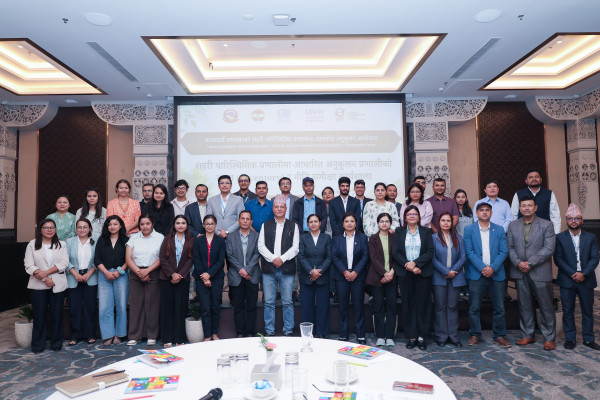
Government representatives, municipal authorities, academia, development partners and UN agencies came together in Kathmandu to discuss opportunities for integrating Ecosystem-based Adaptation (EbA) into urban planning and development in Kathmandu Valley. The consultation brought together stakeholders working across urban development, environment, climate resilience and disaster risk reduction to review urban ecosystem assessment findings, discuss policy recommendations and strengthen collaboration.

The discussions highlighted the growing pressure on natural ecosystems from rapid and unplanned urbanization, contributing to rising temperatures, urban heat islands, flooding, water scarcity and landslide risks. Ms. Sunita Shrestha, National Project Director at the Kathmandu Valley Development Authority (KVDA), highlighted the impacts of recent floods across Nepal and emphasized the importance of nature-based solutions and sustainable urban development in addressing these challenges.

The
workshop presented findings from pilot urban ecosystem inventories conducted in
Madhyapur Thimi, Tokha and Budhanilkantha municipalities. Municipal technical
officers from UN-Habitat shared the assessment results, including Ecosystem
Health Report Cards, a data-driven tool to assess the environmental condition
and evaluate climate adaptation potential of public and open spaces.
The findings
highlighted limited tree canopy and vegetation cover in many surveyed public
spaces, reducing their capacity to regulate local temperatures and mitigate
urban heat. Densely urbanized wards also faced significant shortages of open
spaces, while forest areas performed strongly across environmental indicators.
These findings underscored the importance of protecting existing green
infrastructure, improving public spaces and integrating ecosystem health and
climate resilience considerations into urban planning and development.
Policy experts Top B. Khatri and Santosh Khanal presented the project's policy review and briefs, consolidating findings and recommendations across urban development, environmental management and climate policy. Discussions focused on strengthening policy coherence, translating Nature-based Solutions (NbS) into practical approaches for municipal implementation, addressing institutional coordination challenges and building local technical capacity. Participants also highlighted opportunities to strengthen community forest management to support local livelihoods and enhance groundwater recharge.

Representatives
from government institutions, including KVDA, relevant ministries, the National
Planning Commission, the Department of Urban Development and Building
Construction, and the National Academy of Science and Technology, alongside
municipal leaders, academic institutions, civil society organizations and
development partners, contributed perspectives on advancing EbA in urban
planning and practice.
Tokha
Municipality Mayor Prakash Adhikari highlighted the importance of a “One Ward,
One Park” approach, emphasizing the need to balance urban infrastructure
development with the provision and protection of safe public spaces. KVDA
Development Commissioner Suraj Shakya called for the revival of traditional
Nepali architectural practices, including thick walls and clay-tiled roofs, to
help regulate indoor temperatures. He also cautioned against excessive paving
of open spaces with impermeable materials that can increase surface
temperatures and highlighted the importance of active open-space management.
Ms. Pragya
Pradhan, Habitat Programme Manager at UN-Habitat Nepal, emphasized the
importance of integrating green and grey infrastructure through locally
relevant policies and practical, replicable approaches that strengthen urban
climate resilience.
In her closing remarks, Ms. Sunita Shrestha highlighted plans to translate the project documents into Nepali to improve accessibility and support wider uptake. She also outlined plans to establish a model municipality pilot to demonstrate effective EbA practices and inform their wider application across Kathmandu Valley.

The
consultation was organized under the Urban Ecosystem-based Adaptation for
Climate-Resilient Development in Kathmandu Valley project, jointly implemented
by KVDA and UN-Habitat, with funding from the Global Environment Facility (GEF)
and support from the United Nations Environment Programme (UNEP). The project
aims to strengthen the integration of urban ecosystems into planning and policy
processes, supporting more climate-resilient and sustainable urban development
across the Valley.