Nepal Releases National Water and Sanitation Status Report
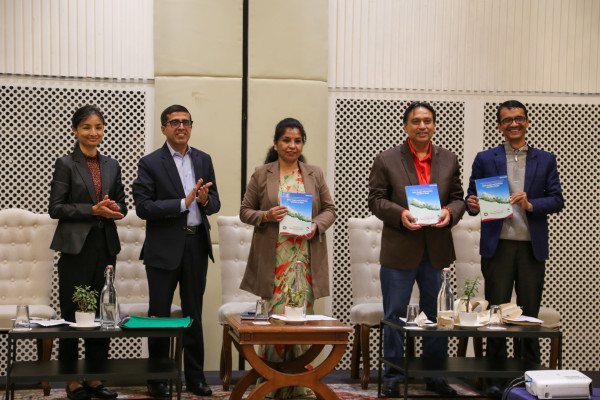
The National Statistics Office (NSO), in partnership with UN-Habitat Nepal, on 30 October 2026 officially launched the “Water Supply and Sanitation Situation in Nepal” thematic report developed under the National Population and Housing Census (NPHC) 2021. The report provides the first comprehensive local-level assessment of drinking water and sanitation services across all 753 municipalities in Nepal by integrating census data with findings from the Nepal Multiple Indicator Cluster Survey (MICS) 2024/25.
The launch event brought together representatives from federal and provincial governments, development partners, WASH sector professionals, local government stakeholders, and media representatives. The report was officially unveiled jointly by Ms. Laxmi Kumari Basnet, Chief Statistician of the National Statistics Office; Mr. Dhundi Raj Lamichhane, Deputy Chief Statistician and NSO Spokesperson; Mr. Madav Prasad Adhikari, Joint Secretary of the Water Supply and Sewerage Management Division, Ministry of Infrastructure Development (MoID); Mr. Sanjeev Bickram Rana, WASH Advisor to MoID; and Ms. Pragya Pradhan, Head of Programme at UN-Habitat Nepal Office.
During the program, Mr. Binod Sharana Acharya, Director of the Social Statistics Division at the National Statistics Office, presented the report’s key findings. The analysis highlights that while Nepal has achieved significant progress in expanding access to basic drinking water and sanitation services, major challenges remain in ensuring safely managed services, water quality, equitable access, and sustainable sanitation management. The report provides localized evidence for all 753 municipalities and introduces a WASH Equity Index to support evidence-based planning and investment decisions.

In his remarks, Mr. Dhundi Raj Lamichhane, Deputy Chief Statistician and NSO Spokesperson, thanked UN-Habitat for its continued partnership and support in developing the report. He highlighted the use of integrated data processing methods that combine national census information with MICS findings, enabling a more comprehensive understanding of Nepal’s water supply and sanitation situation.

Representing UN-Habitat Nepal Office, Ms. Pragya Pradhan, expressed appreciation to the National Statistics Office for the opportunity to collaborate on the initiative. She noted that this report marks the third partnership between NSO and UN-Habitat and reaffirmed the organization’s commitment to making census data more accessible and user-friendly for local governments through innovative approaches. She emphasized that the report would support municipalities in improving service delivery and making informed decisions based on evidence.
Mr. Madav Prasad Adhikari, Joint Secretary of the Water Supply and Sewerage Management Division at MoID, congratulated all institutions involved in the report preparation process. He noted that the findings provide an important basis for planning, prioritization, and investment in the water supply and sanitation sector and will help local governments make decisions grounded in statistical evidence.
Addressing the gathering as the Chair, Ms. Laxmi Kumari Basnet, Chief Statistician of NSO, highlighted the significance of releasing national and local-level data on water supply and sanitation derived from the National Census and MICS. She stated that the report offers a clear picture of access, quality, and disparities in water and sanitation services across provinces and municipalities. She further emphasized that, despite Nepal’s national Open Defecation Free declaration, challenges persist in maintaining sanitation outcomes in some areas. The findings also reveal the continuing burden on women, who spend considerable time collecting water, underscoring the need for improvements that can enhance productivity and well-being. She noted that the report will help identify service gaps and support priority setting in upcoming plans and programs.
The report reveals a significant gap between access to infrastructure and safely managed services. Nationally, 90.0 percent of the population has access to an improved drinking water source on their premises, yet only 47.5 percent use safely managed drinking water services. Similarly, while 92.8 percent of the population uses improved sanitation facilities, only 39.9 percent have access to safely managed sanitation services. These findings emphasize that Nepal’s next challenge is improving service quality, reliability, and safety rather than infrastructure coverage alone.

The report recommends strengthening evidence-based planning, increasing investments in safely managed services, improving water quality monitoring, enhancing fecal sludge and wastewater management, targeting underserved municipalities through equity-based approaches, and strengthening institutional coordination among federal, provincial, and local governments.
The publication was developed through a collaboration between the National Statistics Office (NSO) and UN-Habitat Nepal and is expected to serve as an important resource for policymakers, local governments, development partners, and practitioners working to advance Sustainable Development Goal 6 and achieve equitable access to water supply and sanitation services throughout Nepal.
The full report is available in the following link: https://nsonepal.gov.np/content/13536/water-supply-and-sanitation-sutuaion-in-nepal/