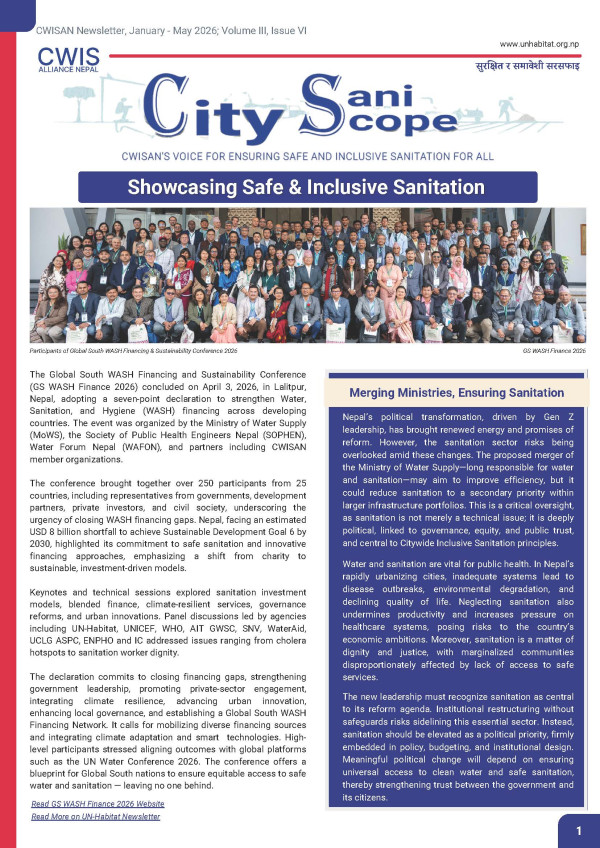
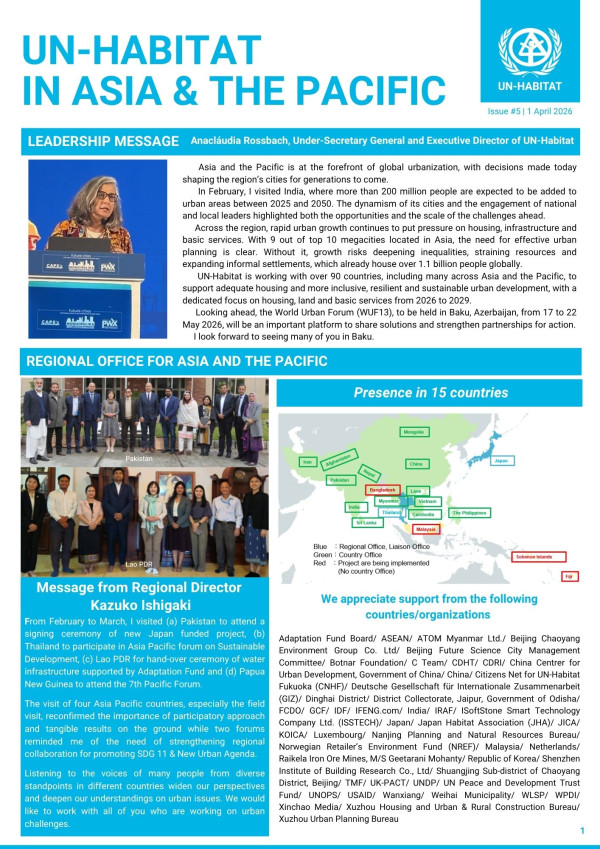
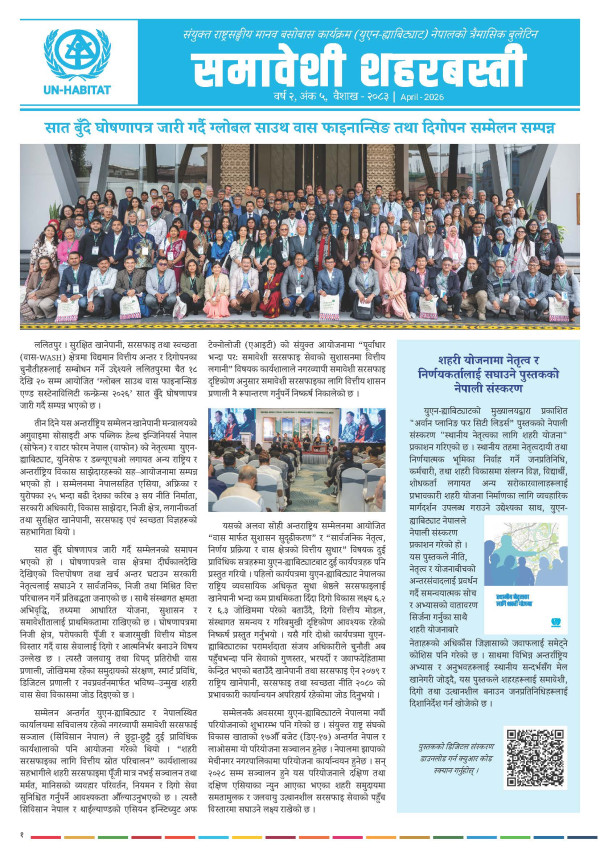
Global South WASH Finance Conference 2026: Financing Governance Must Shift to Deliver Inclusive Sanitation
Kathmandu | 10 April 2026
A joint workshop convened by UN‑Habitat and the Asian
Institute of Technology (AIT) Global Water & Sanitation Center (GWSC) during
the final day of the Global South WASH Financing & Sustainability
Conference (GS WASH Finance 2026) called for fundamental reforms in sanitation
financing governance to translate policy commitments on inclusion into
sustained service delivery. Titled “Beyond Infrastructure: Financing Governance
for Inclusive Sanitation Services,” the workshop, held on 2 April 2026 at The
Plaza Convention Center in Nepal brought together government leaders,
researchers, utilities, development practitioners, and regional experts to
examine structural barriers embedded in current financing systems.
Financing Inclusion as a Governance Issue
Participants highlighted that prevailing sanitation financing frameworks continue to prioritize capital‑intensive infrastructure, often at the expense of long‑term service delivery. Critical elements of inclusive sanitation, such as operation and maintenance, sanitation worker safety, menstrual hygiene management, accessibility for persons with disabilities, and participation of women‑led and small‑scale enterprises, remain inadequately financed or excluded from formal budgetary and procurement processes.

The workshop further underscored the challenge of unfunded decentralization, whereby municipalities are increasingly responsible for delivering inclusive sanitation services without corresponding fiscal authority, predictable transfers, or appropriate financing instruments.
Keynote: Reframing Sanitation Finance
Delivering the session keynote, Prof. Thammarat Koottatep, Co-Director
at AIT‑GWSC, presented The Sanitation Economic Pipeline, reframing sanitation
finance as an integrated system of incentives, risk allocation, and evidence‑based
investment.

Prof. Koottatep emphasized that financing decisions shape outcomes by defining what is rewarded within public systems, whether investment favors one‑time infrastructure outputs or sustained service delivery, whether markets remain accessible to inclusive enterprises, and whether underserved populations are prioritized. He noted that without realigning these incentives, CWIS commitments are unlikely to achieve scale or durability.
Political Leadership and Fiscal Trade‑offs
The session was chaired by Mr. Ashok Kumar Byanju Shrestha,
Immediate Past President of United Cities and Local Governments Asia Pacific
(UCLG ASPAC) and the Municipal Association of Nepal (MuAN). In his reflections,
Mr. Shrestha stressed that inclusive sanitation is ultimately a political
choice, requiring governments to confront real fiscal trade‑offs rather than
relying solely on technical solutions.

Drawing on local government experience, he emphasized that sanitation must be approached as a long‑term public service responsibility, embedded within municipal budgeting, accountability, and decision‑making processes.
Regional Perspectives on Financing Barriers
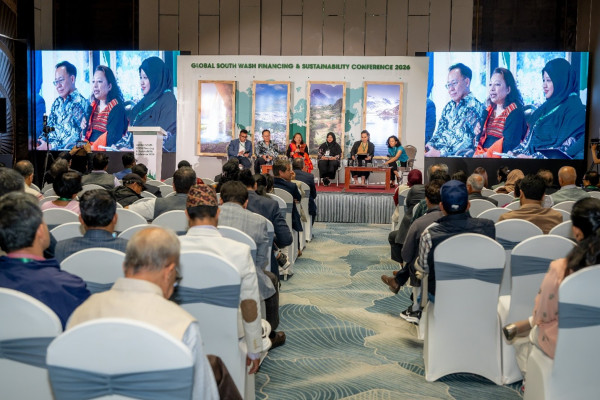
A moderated panel discussion brought together regional and practice‑based perspectives on sanitation financing governance.
Ms. Sudha Shrestha, UN‑Habitat Nepal (CWISAN Secretariat), reflected on Nepal’s CWIS journey, highlighting the gap between national policy commitments and financing practices at the local level.
Dr. Dyah Wulandari Putri, Institut Teknologi Bandung (ITB), Indonesia, shared insights on inclusive and sustainable sanitation and fecal sludge management business models suited to intermediary cities and small island contexts.

Ms. Mahnaz Iftikhar, Khyber Pakhtunkhwa Cities Improvement Project (KPCIP), Pakistan, outlined on‑the‑ground financing and procurement constraints that limit service delivery and inclusion.
Dr. Yuldasheva Salomat Sharofitdinovna, Uzsuvtaminot, Uzbekistan, provided an investor and utility perspective on bankability, risk management, and capital flows in sanitation service provision.
The dialogue was moderated by Ms. Isha Basyal, AIT GWSC, who steered the discussion toward identifying reforms that are not only technically sound, but also politically and institutionally feasible.
Toward Inclusive Sanitation Outcomes
The workshop concluded with broad agreement that achieving CWIS requires shifting the focus from mobilizing additional resources to redesigning financing governance systems. Participants emphasized the need to reform budgeting frameworks, procurement rules, and accountability mechanisms so that inclusion is embedded as a core outcome of public finance systems.

The session reaffirmed that advancing inclusive sanitation
will depend on sustained collaboration among national and local governments,
development partners, research institutions, and utilities to align financing
systems with long‑term public service objectives and ensure no one is left
behind.