CWISAN Workshop Highlights Regional Collaboration for Safe Sanitation at IWA Congress 2025
The International Water Association (IWA) Water & Development Congress and Exhibition 2025 ongoing in Bangkok, Thailand witnessed a landmark session on 12 December 2025 titled “Come Together: The Challenges of an Alliance on Safe Sanitation” that brought together sanitation leaders and alliance representatives from Nepal, Bangladesh, and India to deliberate on sustaining partnerships for inclusive and safe sanitation across South Asia. The workshop was organized by the Citywide Inclusive Sanitation Alliance Nepal (CWISAN) and moderated by Municipal Association of Nepal (MuAN).
The session opened with welcome address from Mayor Narulal Chaudhary, General Secretary of the Municipal Association of Nepal (MuAN) and Mayor of Ghorahi Sub-Metropolitan City. He emphasized the importance of alliances like CWISAN in driving systemic change. “CWISAN has demonstrated that collaboration is the key to addressing complex urban sanitation challenges and ensuring equity and dignity for all. MuAN reaffirms its commitment to advancing CWIS across municipalities in Nepal,” said Mayor Chaudhary.
“CWISAN
has created a platform for coordination that accelerates decision-making and
ensures local voices inform national strategies. This model positions Nepal to
trigger regional collaborations for scaling innovations and harmonizing
standards,” said Pramila Devi Shakya Bajracharya, Secretary of Government of
Nepal, also the program Chair. She further shared Nepal’s transformative
sanitation journey -- from achieving Open Defecation Free (ODF) status in 2019
to implementing Citywide Inclusive Sanitation (CWIS) modules and fecal sludge
management systems. She highlighted CWISAN’s role as a unique alliance bridging
government, municipalities, civil society, and development partners.

A special moment of the event was the participation of Roshan Raj Shrestha, Deputy Director for Water, Sanitation and Hygiene from the Gates Foundation who emphasized that the alliances support political leadership and explore resource optimization strategies to maximize outputs. His remarks underscored the urgency of sustaining alliances beyond donor cycles and leveraging technical expertise within networks.
The workshop also featured insights from regional partners, including ITN-BUET (Bangladesh) and Dasra (India), on strengthening CWIS through policy reforms, financing mechanisms, and capacity-building initiatives. Discussions revolved around CWISAN’s strategic focus areas—policy and monitoring, advocacy, and capacity building—and its challenges such as resource sustainability and aligning diverse mandates.

Adding a local dimension to the global dialogue, CWISAN members in Kathmandu joined the event via live viewing at the UN-Habitat Nepal Office, reinforcing the alliance’s commitment to inclusive participation and knowledge exchange.
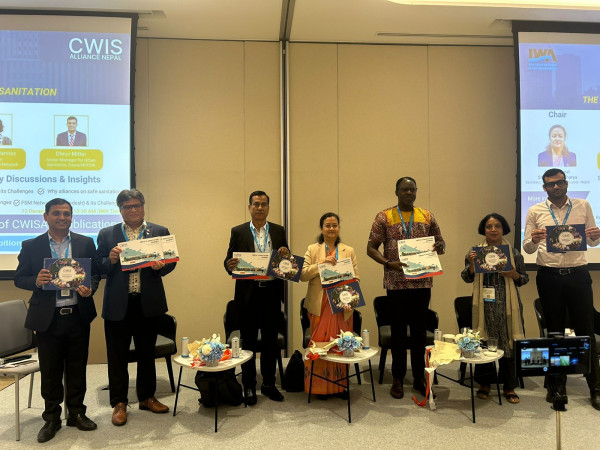
The same event also marked the launch of two latest CWISAN publications: 1) Nepal's Sanitation Journey – Towards Achieving SDG 6.2 Goals; 2) Compendium of Best Practices in Nepal.
The publications were jointly unveiled by the Program Chair, Special Invitee Dr. Roshan Raj Shrestha, MuAN General Secretary Mayor Narulal Chaudhary, and the distinguished panelists, symbolizing a collective commitment to advancing safe sanitation through evidence-based practices and shared learning.
The
session concluded with a call to action for alliances to pool resources, expand
regional networks, and develop a shared roadmap toward achieving SDG 6.2 –
safely managed sanitation for all by 2030.